
Northern soul is the strangest success story in British music. A scene built entirely on American records that failed in America, danced to in northern English ballrooms by people who had never been near Detroit or Chicago, kept alive for more than fifty years by collectors who treat a seven-inch single the way other people treat a painting. It produced no bands of its own. It had no hit records, by definition. And it is still going.
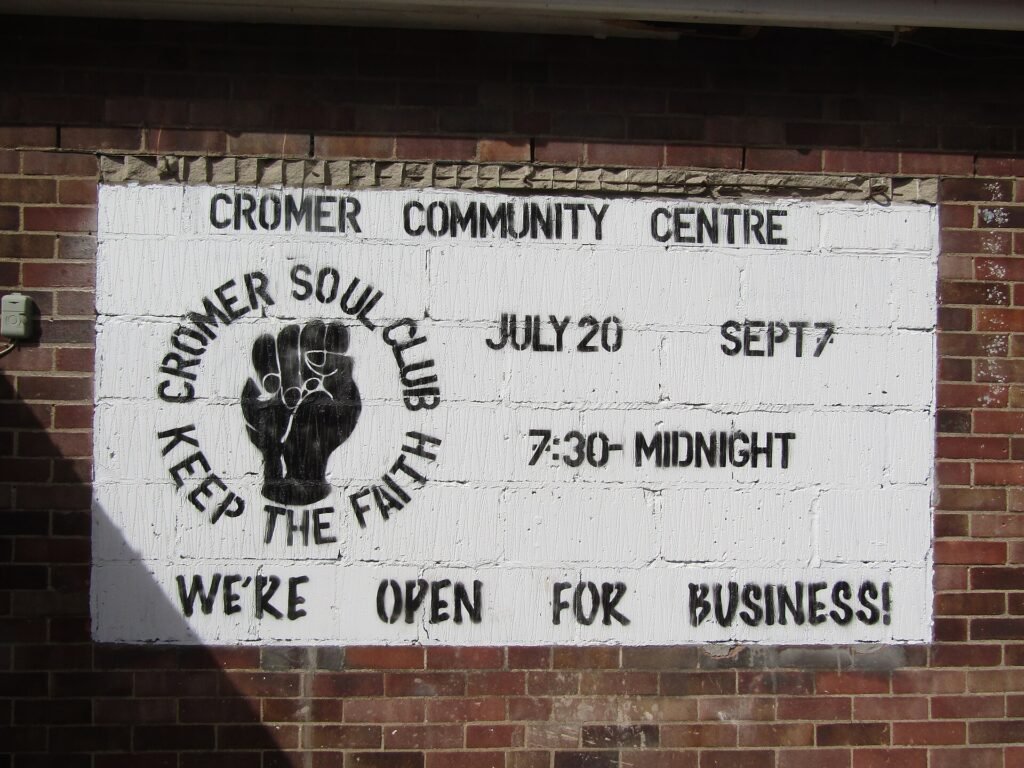
If you have arrived here because you saw the clenched fist on a patch, or heard the phrase in a documentary, or found a stack of odd-looking 45s in a relative’s loft, this is the guide we wish had existed when we started. It covers where northern soul came from, what the records actually sound like, which clubs mattered and why, and how to start listening without spending money you do not have.
What northern soul actually is
Northern soul is not a genre of music. This is the single most important thing to understand, and the thing most introductions get wrong.
No artist ever set out to make a northern soul record. The records were made in the United States, mostly between 1964 and 1972, by American soul singers hoping for an American hit. They were released on small independent labels in Detroit, Chicago, Philadelphia, Los Angeles and a hundred smaller towns. Almost all of them flopped. They were pressed in tiny quantities, sold badly, and were forgotten within months.
Northern soul is what happened when British dancers, a few years later and three thousand miles away, decided those failures were the best records ever made.
So the genre is defined by its audience, not its makers. A record becomes northern soul because a British DJ played it at an all-nighter and the floor responded. That is the whole qualification. This is why the canon can seem arbitrary to outsiders and why arguments about what counts have run for five decades without resolution.
The sound
Within that looseness there is a recognisable template. The classic northern soul record runs fast, typically above 100 beats per minute, with a heavy four-to-the-floor stomp and a syncopated push underneath it. There are usually strings or horns doing something urgent. The vocal is pleading rather than smooth. The whole thing is over in two and a half minutes.
Crucially, it sounds like Motown but is not Motown. The scene deliberately avoided the big Detroit hits, partly out of a collector’s instinct for the obscure and partly because the point was to hear something nobody else had. A record everyone owned was worthless on the dancefloor, whatever it sounded like.
That tension, between wanting music that moves a room and wanting music nobody else can get, is the engine of the entire scene. It explains the rarity obsession, the prices, the secrecy, and a fair amount of the bad behaviour.
Where the name came from
The term was coined by Dave Godin, who ran the Soul City record shop in Covent Garden, London, and wrote for Blues & Soul magazine. He used it publicly in print in June 1970, though he said afterwards that he had been using it around the shop since about 1968 as a piece of staff shorthand.
The logic was commercial, not romantic. Godin noticed that customers travelling down from the north of England wanted a different kind of soul record than his London regulars. Londoners were moving toward the newer, funkier, slower material. The northern visitors wanted the fast, punchy, mid-sixties uptempo stuff that had gone out of fashion in the capital. Rather than explain this to every new member of staff, Godin started telling them to show northern customers the “northern soul” box.
A filing category became the name of a movement. There is something very fitting about that.
The clubs
You cannot separate the records from the rooms. Northern soul was a dancing culture before it was a listening culture, and each significant venue had its own sound, its own DJs and its own politics.
The Twisted Wheel, Manchester
The origin point. The Twisted Wheel ran through the 1960s until 1971 and is generally treated as the first properly northern soul venue, though at the time nobody called it that. Its all-nighters established the format everyone else copied: an overnight session, American soul imports, and a crowd that had travelled to be there. When it closed the audience scattered, and the scene it had concentrated in one Manchester basement spread across the north.
The Golden Torch, Stoke-on-Trent
Picked up much of the Twisted Wheel crowd from late 1970. Its run was short but its influence was not: it proved the scene could survive the loss of its original home, and it moved the centre of gravity out of Manchester.
Wigan Casino
The famous one. The Casino ran all-nighters from September 1973 to 1981, from two in the morning until eight, and at its peak it was the largest and best known soul venue in Britain. It is the room most people picture when they picture northern soul: the talcum powder on the boards, the spins and backdrops, the badges.
Every Casino all-nighter closed with the same three records, a ritual known as the “3 before 8”: Jimmy Radcliffe’s “Long After Tonight Is Over”, Tobi Legend’s “Time Will Pass You By” and Dean Parrish’s “I’m On My Way”. If you want to understand the emotional register of this scene, listen to those three in sequence at seven in the morning. They are songs about endings, played to people who did not want the night to end.
Blackpool Mecca
The Casino’s rival and, for a certain kind of purist, its superior. The Mecca ran a more forward-looking policy, pushing newer and funkier records while Wigan held the line on the sixties stomper sound. The resulting argument split the scene for years. With hindsight both sides were right about something: the Mecca’s direction fed into what became modern soul and eventually British dance culture, while Wigan preserved a canon that would otherwise have been lost.
The Catacombs and Va Va’s
Wolverhampton and Bolton respectively, both active through the 1970s, both smaller and both deeply respected by people who were there. The Catacombs in particular has a reputation among collectors for a deeper, less obvious playlist than the bigger rooms.
The DJs, the cover-ups and the arms race
The northern soul DJ was not a host. He was a collector performing his collection, and his standing depended entirely on playing records nobody else could play. This produced one of the strangest practices in music culture: the cover-up.
A DJ who found an unknown record would peel off the label, or stick a blank over it, and announce the track under a false artist and title of his own invention. The crowd would go home wanting the record. Nobody could find it, because it did not exist under that name. The DJ kept his exclusive, sometimes for years.
Some cover-ups were eventually blown when a rival identified the record. Some were never cracked and the real identity only emerged decades later, when the DJ died or finally gave it up. There are tracks that circulated on the scene under a fake name for so long that the fake name is now the one people use.
It sounds petty written down, and some of it was. But it also drove an extraordinary amount of genuine archaeology. DJs flew to the United States and bought out the back rooms of defunct record distributors in Detroit and Chicago. They wrote letters to labels that had not existed for a decade. Boxes of unsold stock that would otherwise have gone to landfill were rescued because a man from Stoke wanted something to play at two in the morning. A significant portion of what survives of American independent soul survives because of that competitive obsession.
The other consequence was inflation. Once a record was known, and known to be rare, the price moved. The scene effectively invented a market for objects that had been commercially worthless five years earlier, and it has never stopped.
The clenched fist, and what it meant
The clenched fist badge, now sold on t-shirts in shops that have no idea what it refers to, comes directly from the American Black Power movement of the 1960s. Dave Godin recorded in 1971 that dancers were wearing black “right on now” racing gloves and throwing the fist on the floor.
This deserves more thought than it usually gets. A largely white, largely working-class British audience adopted the visual language of Black American political struggle as a dancefloor gesture, attached to records made by Black American artists who in most cases never earned a living from them. That is not a simple story, and the scene has never fully reckoned with it. It is worth knowing about rather than glossing over, and it is one reason the best writing on northern soul spends time on the artists rather than only on the collectors.
The rarity problem
Because the records were pressed in small numbers and then thrown away, supply is genuinely tiny. Combine that with fifty years of demand from a committed international collector base and you get prices that make no sense to anyone outside the scene.
The standard example is Frank Wilson’s “Do I Love You (Indeed I Do)”, generally described as the rarest and most valuable northern soul single in existence. It was a Motown recording that was withdrawn before release; the surviving copies can be counted on your fingers. In December 2014, a London Records pressing of Darrell Banks’ “Open the Door to Your Heart”, believed to be the only surviving copy of that particular version, went for over £11,000.
Here is the part that matters for anyone starting out: you do not need any of this. The music on those records is available. Reissue labels have spent the last two decades doing the archival work, licensing properly and pressing affordable vinyl. The original is a collectors’ object; the song is not. Confusing the two is the fastest way to spend a great deal of money and enjoy yourself very little.
If you want to go deeper on where the legitimate reissues come from, we have written a separate guide to the soul and funk reissue labels worth following.
Twenty records to start with
This is not a rarity list and it is not a canon. It is twenty records that will teach your ear what the scene sounds like, chosen because they are good and because you can hear all of them without a second mortgage.
- Frank Wilson — “Do I Love You (Indeed I Do)”
- Gloria Jones — “Tainted Love”
- Dobie Gray — “Out on the Floor”
- Jimmy Radcliffe — “Long After Tonight Is Over”
- Tobi Legend — “Time Will Pass You By”
- Dean Parrish — “I’m On My Way”
- R. Dean Taylor — “There’s a Ghost in My House”
- The Velvelettes — “Needle in a Haystack”
- Darrell Banks — “Open the Door to Your Heart”
- Al Wilson — “The Snake”
- The Tams — “Hey Girl Don’t Bother Me”
- Jackie Wilson — “(Your Love Keeps Lifting Me) Higher and Higher”
- Edwin Starr — “Agent Double-O-Soul”
- Barbara Acklin — “Am I the Same Girl”
- The Exciters — “Blowing Up My Mind”
- Bob & Earl — “Harlem Shuffle”
- Chuck Wood — “Seven Days Too Long”
- The Salvadors — “Stick By Me Baby”
- Little Anthony & The Imperials — “Better Use Your Head”
- Maxine Brown — “Oh No Not My Baby”
Play them loud and in order and you will hear the template assemble itself: the stomp, the urgency, the two-and-a-half-minute discipline.
How to start listening properly
Start with compilations, not singles. Kent Records, the reissue arm of Ace Records in London, has been licensing and compiling this material for decades and their series are the most reliable education available. Buying one well-chosen compilation teaches you more than six months of random single purchases.
Learn the labels before you learn the prices. Ric-Tic, Golden World, Okeh, Mirwood, Shrine, Cameo-Parkway. Once you recognise the imprints you start to hear house styles, and the scene stops being a flat list of songs and becomes a map.
Ignore the value guides for the first year. Price is a function of scarcity, not quality. Some of the most expensive northern soul records are mediocre songs that happen to be almost impossible to find. Some of the best are common as muck.
Go to a night. This music was engineered for a room full of people at four in the morning and it does not fully make sense through headphones. Soul nights run all over the UK and increasingly across Europe, and the crowd is generally far more welcoming to newcomers than the scene’s reputation suggests.
Is northern soul still alive?
Yes, in three separate forms, and they do not always get on.
There is the original scene, now in its sixties and seventies, still running nights and still arguing about Wigan versus the Mecca. There is the collector economy, which is international, online and increasingly expensive, driven as much by Japanese and Northern European buyers as British ones. And there is the reissue and DJ culture, a younger audience that came to the records through digital crate-digging and modern labels rather than through the clubs.
The 2014 film Northern Soul brought a wave of new interest, with the mixed results these things usually have: more people listening, and more people buying the t-shirt without the records.
None of that changes the basic fact. Somewhere in the north of England this weekend, a room full of people will dance until morning to records that failed in 1967. That is a remarkable thing for any music to achieve, and these particular records earned it.
What northern soul gave to British music
The scene’s influence runs a long way past the records it played, and most of it is unacknowledged.
It built the template for British club culture. The all-nighter, the DJ as the draw rather than a band, the travelling crowd, the sense that the room is the event — all of that was standard practice in Wigan a decade before acid house. When British dance culture exploded in the late eighties it was reinventing a wheel that northern soul had already built, and quite a few of the people involved knew it.
It created the British record collector as a type. The obsessive discographical knowledge, the willingness to spend absurd sums on an obscure single, the preference for the unknown over the good — that sensibility fed directly into rare groove, into hip-hop crate-digging in the UK, and into the reissue culture that now keeps this music in print.
It kept a body of American music alive that America had discarded. This is the largest debt. Hundreds of singles that had no commercial life and no archival value to anyone in the United States survived because British collectors wanted them. When the reissue labels came along in the 1990s and 2000s to do the job properly, the records were findable because the scene had spent thirty years finding them.
It fed back into the charts. Several northern soul staples became belated UK hits years after their American failure, and the scene’s taste shaped what British labels bothered to license. Soft Cell’s version of “Tainted Love” — a Gloria Jones record that was pure northern soul club fare — is the most visible example of a much broader pattern.
Frequently asked questions
Why is it called northern soul if the music is American?
The “northern” refers to the audience, not the artists. Dave Godin used it to describe what customers from the north of England were buying at his London shop, as distinct from what Londoners wanted. All the records themselves are American.
What tempo is northern soul?
Typically above 100 bpm, often considerably above. The fast, insistent four-to-the-floor beat is the most reliable single marker of the style.
Do I need original pressings?
No. Originals are collectors’ items and are priced accordingly. Licensed reissues and compilations contain the same music, sound good, and put money back toward the rights holders. Start there.
What is the rarest northern soul record?
Frank Wilson’s “Do I Love You (Indeed I Do)” is the usual answer, a withdrawn Motown release surviving in single figures. Individual pressings of other records have sold for extraordinary sums, including a Darrell Banks London Records copy that passed £11,000 in 2014.
What does “keep the faith” mean?
It is the scene’s motto, paired with the clenched fist borrowed from Black Power iconography. In practice it means staying loyal to the music and the all-nighter culture rather than following whatever is fashionable.