
Stax Records was a record shop in the foyer of a disused cinema in a Black neighbourhood of Memphis, run by a bank clerk who played fiddle and his sister who remortgaged her house to buy a tape recorder. Over the next eighteen years it produced Otis Redding, Booker T. & the M.G.’s, Sam & Dave, Isaac Hayes and Wattstax, and then it went bankrupt so comprehensively that the building was demolished.
This is the story of Stax Records: how the label worked, why the records sound the way they do, the contract that destroyed it, and what to listen to.
Satellite, and the name
The label was founded in 1957 as Satellite Records by Jim Stewart, a Memphis bank employee and part-time country fiddler, and his sister Estelle Axton. In September 1961 they renamed it, combining their surnames: STewart plus AXton equals Stax.
The operation moved into 926 East McLemore Avenue, a former movie theatre called the Capitol. This matters more than it sounds. The studio was the auditorium, which meant it had a sloping floor and the acoustics of a room built for a different purpose entirely. Nobody designed the Stax sound; it was a by-product of recording in a cinema.
Estelle Axton ran a record shop in the old foyer. That was the label’s research department: staff could put a new pressing on and watch what teenagers actually bought. Very few record companies in history have had a more direct feedback loop.
The house band
By mid-1962 Stax had assembled Booker T. & the M.G.’s: Booker T. Jones on keyboards, Steve Cropper on guitar, Donald “Duck” Dunn on bass and Al Jackson Jr. on drums. Add Isaac Hayes and David Porter, who wrote and produced, and you have what the label called the Big Six.
Two things about this band are worth stating plainly.
The first is that it was racially integrated — Jones and Jackson Black, Cropper and Dunn white — in Memphis, in the early 1960s. That was not normal and it was not safe, and everyone involved has been clear that the studio operated as a bubble inside a city that did not work that way.
The second is musical, and it is the reason any of this is still listened to. The M.G.’s were an economy machine. Cropper’s guitar parts are mostly two or three notes. Dunn’s bass lines sit dead in the pocket and almost never show off. Jackson’s drumming is the most disciplined in soul music. Nothing is difficult. Everything is exactly where it needs to be.
Compare it to what was happening at Motown in the same years, where the arrangements are dense, layered, orchestral and aimed squarely at the pop charts. Stax left holes. That is the whole difference between the two labels, and it is audible within four bars.
What the Stax Records sound actually is
Four identifiable things, and you can hear all of them on almost any record the label made before 1968.
The horns are the hook
Where most pop music puts the memorable line in the vocal or the guitar, Stax put it in the horns. The Memphis Horns — Wayne Jackson on trumpet, Andrew Love on tenor — wrote riffs rather than pads. Take the horns out of “Soul Man” or “Knock on Wood” and you have removed the song.
Nothing doubles anything
Each instrument occupies its own space. The guitar does not reinforce the bass; the keyboard does not thicken the horns. This is why Stax records sound loud at low volume: there is nothing competing.
The drums sit slightly back
Al Jackson Jr. was known as the Human Timekeeper, and the steadiness is the point. He plays fractionally behind the beat and never varies, which is what allows everyone else to push against something solid.
The room
A cinema auditorium with a sloping floor is a strange place to record. The natural ambience of that space is on every record cut there, and it could not be replicated after the building came down — one reason the museum’s replica, faithful as it is, is a museum rather than a studio.
The Atlantic contract
In 1965 Jim Stewart signed a national distribution deal with Atlantic Records. He did not read the contract.
That sentence is not editorial embellishment; it is the documented account. Buried in the agreement was a clause giving Atlantic “all right, title and interest” in every recording distributed under the deal. Stax thought it was hiring a distributor. It was signing away ownership of its masters.
The bill arrived in 1967, when Atlantic was sold to Warner Bros.-Seven Arts. Stewart tried to renegotiate and to recover the tapes. He was refused. Everything Stax had recorded between 1960 and 1967 — the entire Otis Redding catalogue, Sam & Dave, the M.G.’s instrumentals, all of it — belonged to somebody else.
On 13 May 1968, Stewart sold Stax to Paramount Pictures.
It is worth sitting with the scale of that. A label that had produced some of the most important American records of the decade lost all of them because of a clause nobody read. Whatever you think of the music business, the paperwork is the business.
December 1967
Six months before the sale, on 10 December 1967, Otis Redding’s plane came down. Most of the Bar-Kays died with him.
Redding was twenty-six. He had just recorded “(Sittin’ On) The Dock of the Bay”, which would become the first posthumous number one in American chart history. He was, by every account, about to become the biggest soul artist in the world.
For the label it was not only a human catastrophe but an existential one. Stax lost its defining artist and its back catalogue within six months of each other.
The second Stax
What happened next is the part people forget, and it is arguably more interesting than the first act.
Al Bell, who had joined as a marketing executive, became vice president and co-owner after 1968 and sole owner from 1972. Faced with a label that owned nothing, he did the only available thing: he rebuilt the catalogue from zero, at volume, fast.
The second Stax sounds different. It is bigger, funkier, more orchestral, more explicitly political. Isaac Hayes turns into a solo artist and makes Hot Buttered Soul and then Shaft. The Staple Singers arrive. The label starts releasing gospel, comedy and spoken word. It stops being a Memphis studio operation and starts behaving like a Black-owned corporation with a cultural programme.
The high point was Wattstax: on 20 August 1972, Stax staged a festival in Los Angeles that drew over 100,000 people, filmed by Mel Stuart and released by Columbia Pictures in February 1973. It has been called the Black Woodstock, which undersells it — Woodstock did not have a functioning record label behind it making an argument about who the music belonged to.
The collapse
It ended badly and quickly. Financial mismanagement, a disastrous distribution arrangement with CBS and a bank foreclosure pushed the label into involuntary bankruptcy on 19 December 1975. Stax closed on 12 January 1976. Fantasy Records picked up the post-1968 catalogue in 1977.
The building at 926 East McLemore stood empty until 1989, when it was demolished. A cinema that became the most important soul studio in America was knocked down, and for fourteen years there was nothing there at all.
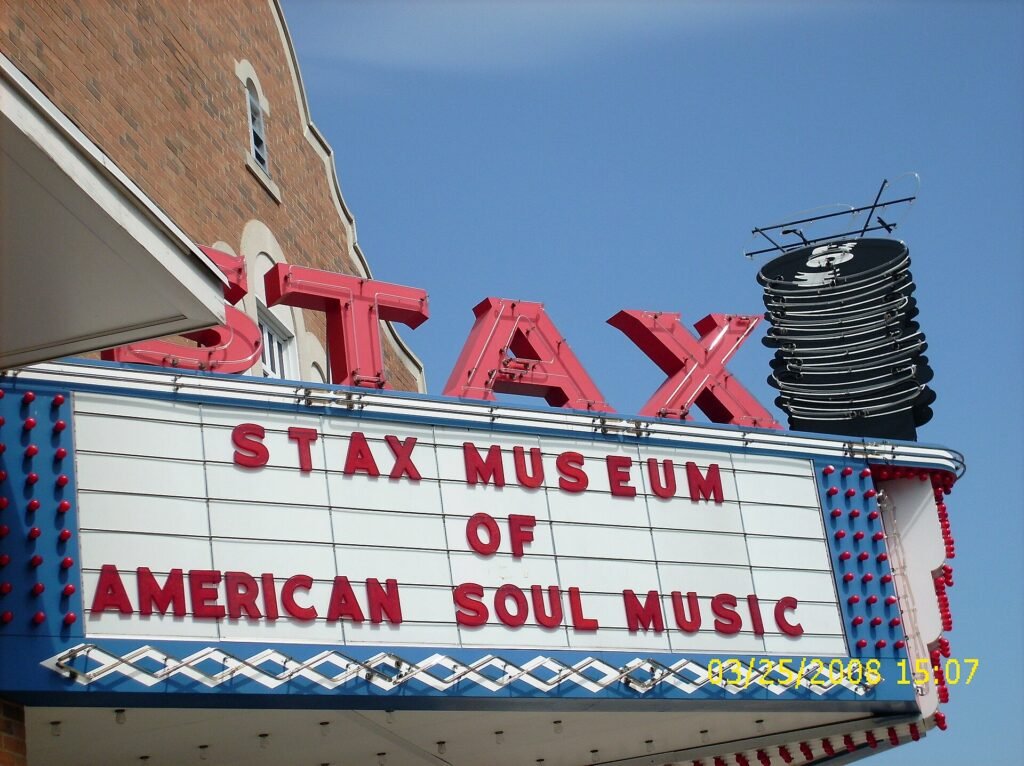
The Stax Museum of American Soul Music opened on the site in 2003, run by the Soulsville Foundation, in a replica of the original building. It is worth visiting, and it is also a slightly melancholy object: a reconstruction of something that was thrown away.
Stax Records: what to listen to
Split by era, because the two Staxes are genuinely different propositions.
The first Stax, 1961–1968
- Otis Redding — Otis Blue (1965). The one. Recorded in about 24 hours.
- Booker T. & the M.G.’s — “Green Onions” (1962). The house band’s own hit, and a masterclass in doing almost nothing.
- Sam & Dave — “Soul Man” and “Hold On, I’m Comin'”. Hayes and Porter songs, and the best double act in soul.
- William Bell — “You Don’t Miss Your Water” (1961). Early, slow, foundational.
- Carla Thomas — “Gee Whiz”. Rufus Thomas’s daughter, and the label’s first real star.
- Eddie Floyd — “Knock on Wood”.
The second Stax, 1969–1975
- Isaac Hayes — Hot Buttered Soul (1969). Four tracks, one of them eighteen minutes. Changed what a soul album could be.
- The Staple Singers — “I’ll Take You There” (1972). Cut at Muscle Shoals rather than Memphis, which tells you how the operation had changed.
- Johnnie Taylor — “Who’s Making Love” (1968). The record that proved the label could survive Redding.
- Wattstax, the film and the albums.
Stax against Motown
The comparison is unavoidable and usually reduced to a slogan, so here is the useful version.
Motown was a factory with quality control. Berry Gordy built a system: writers competed, releases were voted on, the Funk Brothers played everything, and the target was the pop chart and the white American living room. The records are immaculate, dense and enormously sophisticated.
Stax was a room with a band in it. Records were cut fast, often live, by whoever was around. There was no quality control committee. The target was whatever moved records out of Estelle Axton’s shop.
The results diverge accordingly. Motown records are arrangements. Stax records are performances. Motown is tighter; Stax breathes. Motown conquered the mainstream; Stax kept a closer relationship with the music’s Southern and gospel roots.
Neither is better. But if you have spent your life with Motown and never worked through Stax, you are missing half of the argument about what soul music was for.
If you want the wider Southern picture, our guide to Muscle Shoals covers the Alabama studios that Stax was constantly compared to, and our deep soul listening guide puts several of these records in context.
Frequently asked questions
What does Stax stand for?
It is a contraction of the founders’ surnames: Jim Stewart and Estelle Axton. The label was called Satellite Records until September 1961.
Why did Stax Records fail?
Two blows and then a third. The 1965 Atlantic contract cost it ownership of its entire 1960–1967 catalogue. Otis Redding died in December 1967. After rebuilding under Al Bell, a failed CBS distribution deal and a bank foreclosure forced bankruptcy on 19 December 1975; the label closed on 12 January 1976.
Who was the Stax Records house band?
Booker T. & the M.G.’s — Booker T. Jones, Steve Cropper, Duck Dunn and Al Jackson Jr. — with Isaac Hayes and David Porter writing and producing. Collectively known at the label as the Big Six.
Can you visit Stax Records?
The original building was demolished in 1989. The Stax Museum of American Soul Music opened on the site at 926 East McLemore Avenue in 2003, in a replica of the original, operated by the Soulsville Foundation.
What is the difference between Stax and Motown?
Stax recorded fast and live in Memphis with a single house band and left space in the arrangements. Motown built a Detroit hit factory with competing writers, dense orchestration and an explicit pop-chart target. Stax records are performances; Motown records are arrangements.